
On this pageShowHide
Contents
3 sections • ~6 min
 Verified Guide
Overview of the German A1 Syllabus
Direct Answer
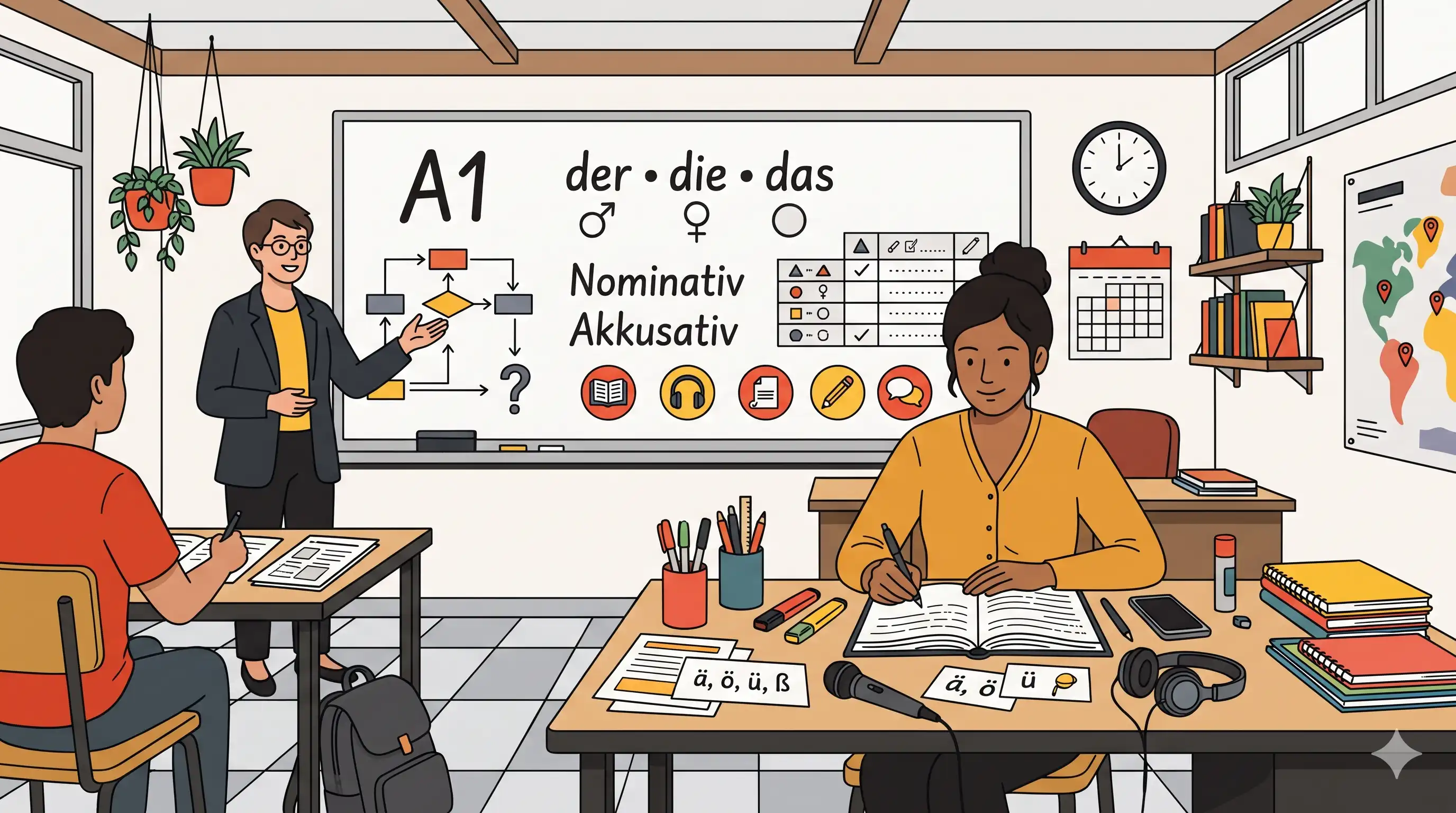
The German A1 syllabus introduces beginners to phonetics, noun genders (der, die, das), Nominativ and Akkusativ cases, present tense verb conjugation, modal verbs (können, müssen, möchten), separable verbs (aufstehen), and negation (nicht/kein). It covers four integrated skills: reading, listening, writing, and speaking.
Learners enrolled in our German A1 course in Hisar follow this curriculum step by step with interactive exercises.
Core Grammar Modules in A1
- Personal Pronouns & Verbs: ich, du, er, sie, es, wir, ihr, sie, Sie with regular suffixes (-e, -st, -t, -en, -t, -en).
- Articles & Genders: Masculine (der/ein), Feminine (die/eine), Neuter (das/ein), and Plural (die/-).
- Akkusativ Case: Masculine changes to den / einen / keinen, while feminine, neuter, and plural remain unchanged.
- Questions: W-Fragen (Wer, Wie, Wo, Woher, Was, Wann, Warum) and Ja/Nein questions starting with the verb.
- Separable Verbs: The prefix moves to the very end of the clause: Ich stehe um 7 Uhr auf.
Frequently Asked Questions
Does German A1 include past tense?
A1 primarily focuses on the present tense (Präsens). A basic spoken introduction to Perfekt with 'haben' and 'sein' is given near the end, while comprehensive past tense mastery is taught in A2.
How many vocabulary words are in the Goethe A1 exam?
The official Goethe-Zertifikat A1 vocabulary list contains approximately 650 essential everyday words.
Ankush Dhanda
Founder & Lead Trainer • Fluent German Academy
Specialized in A1–B2 German language instruction, spoken German confidence, and Goethe/telc exam preparation methodology in Hisar.