
On this pageShowHide
Contents
3 sections • ~6 min
 Verified Guide
Top Grammatical Mistakes & How to Fix Them
Direct Answer
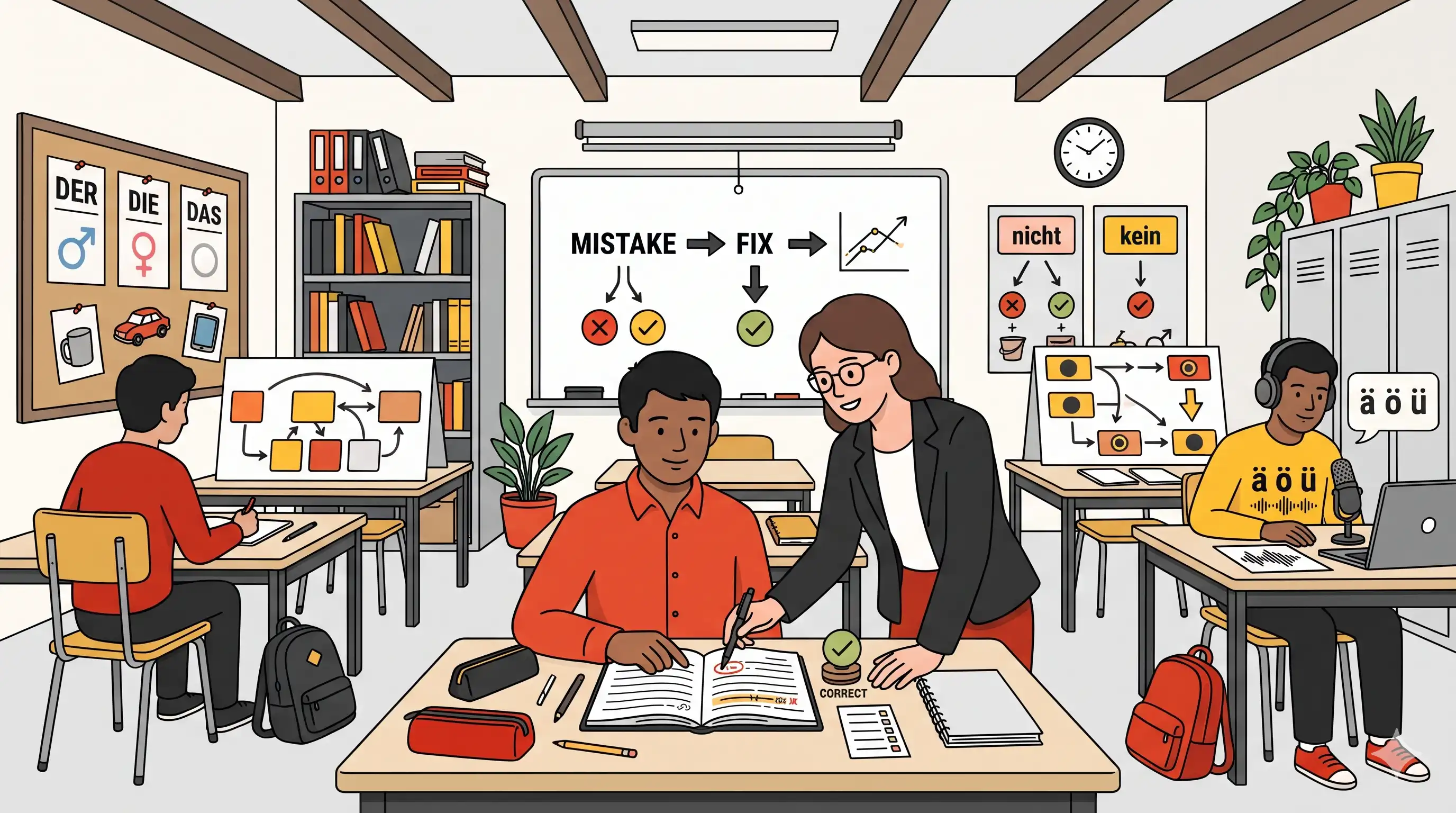
German grammar is logical, but its structural rules differ from English and Hindi. The five most frequent beginner errors are: neglecting noun articles, violating Verb-Zweitstellung, confusing nicht and kein, mixing up Akkusativ and Dativ prepositions, and mispronouncing umlauts.
In our classroom sessions at Fluent German Academy in Hisar, we address these errors systematically through daily correction.
3 Major Beginner Traps with Explanations
1. Memorizing Nouns Without Gender
Mistake: Learning "Tisch = table".
Fix: Always learn "der Tisch" with its article and plural "die Tische". Without the article, you will make errors in every single case inflection.
2. Confusing 'nicht' and 'kein'
Mistake: Ich habe nicht Hund. ❌
Fix: Ich habe keinen Hund. ✅ (Use 'kein' when replacing 'ein' or zero article; use 'nicht' for verbs and adjectives).
3. Word Order in Subordinate Clauses (Nebensätze)
Mistake: Ich lerne Deutsch, weil ich will in Deutschland studieren. ❌
Fix: Ich lerne Deutsch, weil ich in Deutschland studieren will. ✅ (In clauses starting with weil, dass, wenn, the conjugated verb kicks to the very end).
Frequently Asked Questions
Why should I always learn German nouns with their article?
Because German grammatical gender (masculine, feminine, neuter) is unpredictable. If you don't know whether a noun is der, die, or das, you cannot apply the correct Akkusativ, Dativ, or adjective endings later.
What is the difference between 'nicht' and 'kein'?
'Kein' negates nouns with indefinite articles or no article (Ich habe kein Auto). 'Nicht' negates verbs, adjectives, adverbs, and nouns preceded by definite articles (Ich schlafe nicht; Das Auto ist nicht rot).

Ankush Dhanda
Founder & Lead Trainer • Fluent German Academy
Specialized in A1–B2 German language instruction, spoken German confidence, and Goethe/telc exam preparation methodology in Hisar.