
On this pageShowHide
Contents
3 sections • ~6 min
 Verified Guide
Overview of German Phonetics
Direct Answer
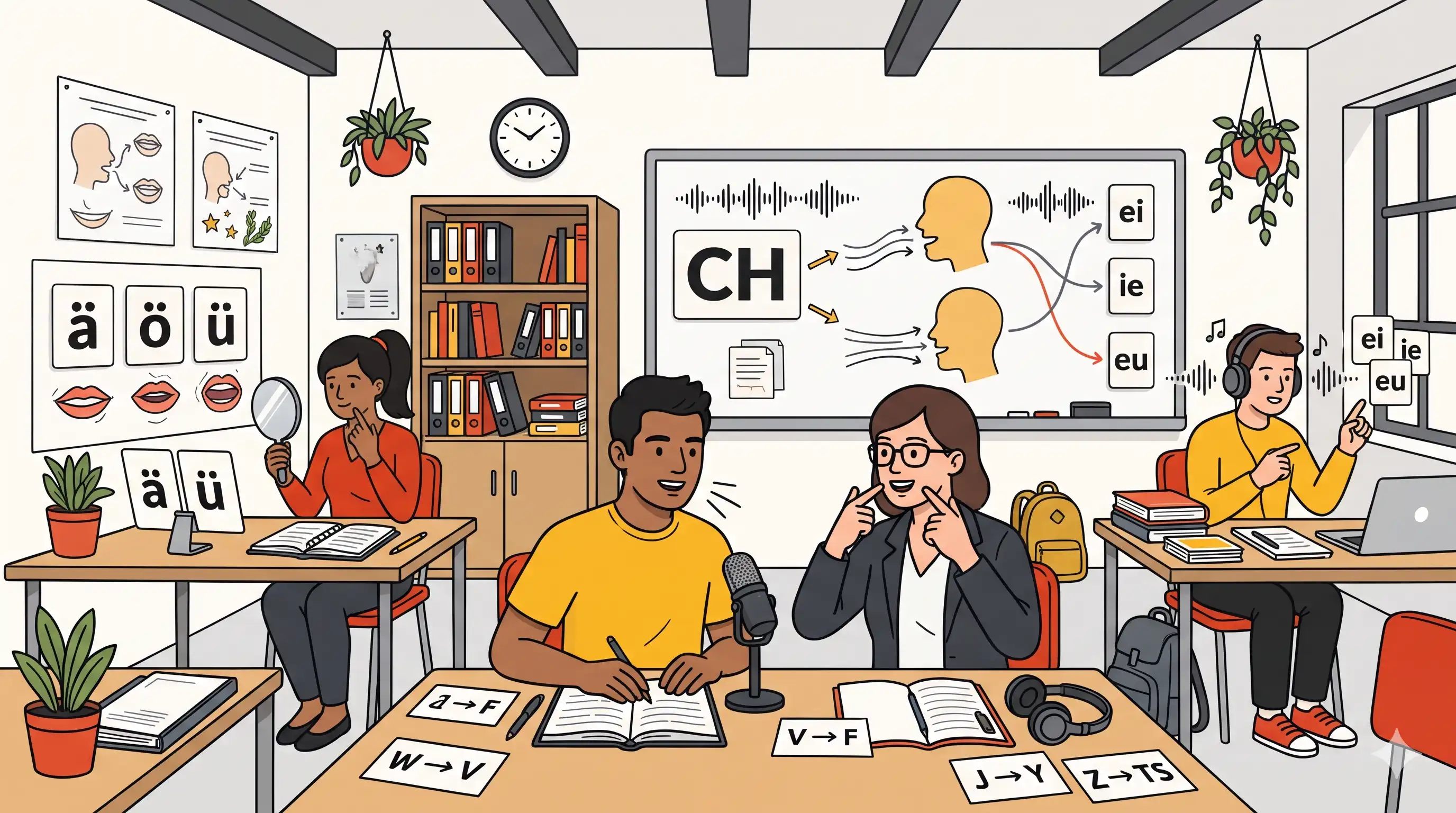
Unlike English, German is largely phonetic: words sound the way they are written. By mastering five fundamental phonetic rules — consonant shifts (W as V, V as F), the two CH sounds, diphthong combinations, and the three umlauts (ä, ö, ü) — Indian learners can achieve clear, authentic German pronunciation within their first two weeks.
At Fluent German Academy in Hisar, pronunciation drills form an essential part of every A1 classroom session.
Key German Sounds & Practical Examples
1. German Diphthongs
- ei / ai: Pronounced like English "eye" (mein, Wein, Mai)
- ie: Pronounced like a long "ee" (sie, Bier, Wien)
- eu / äu: Pronounced like "oy" in boy (heute, Häuser, Euro)
2. The Two 'CH' Sounds
- Ich-Laut (soft hiss): Pronounced near the front of the palate after e, i (ich, nicht, sprechen).
- Ach-Laut (guttural): Pronounced in the back of the throat after a, o, u (Buch, machen, doch).
3. Consonant Specifics
- W: Always pronounced as English "V" (Wasser, wo, wie).
- V: Usually pronounced as English "F" (Vater, vier, viel).
- J: Pronounced like English "Y" (ja, jetzt, Jugend).
- Z: Pronounced as "ts" (Zug, Zeit, zusammen).
Frequently Asked Questions
How do I pronounce the German umlauts (ä, ö, ü)?
For 'ä', say a wide 'eh' (Mädchen). For 'ö', shape your lips to say 'oh' but pronounce 'eh' (schön). For 'ü', round your lips to say 'oo' but pronounce 'ee' (über).
What is the difference between the two 'ch' sounds in German?
After back vowels (a, o, u, au), 'ch' is a guttural throat friction sound (Ach-Laut: Bach, Buch). After front vowels (e, i, ä, ö, ü, ei, eu) and consonants, it is a soft palatal hiss like a cat (Ich-Laut: ich, Milch).

Ankush Dhanda
Founder & Lead Trainer • Fluent German Academy
Specialized in A1–B2 German language instruction, spoken German confidence, and Goethe/telc exam preparation methodology in Hisar.